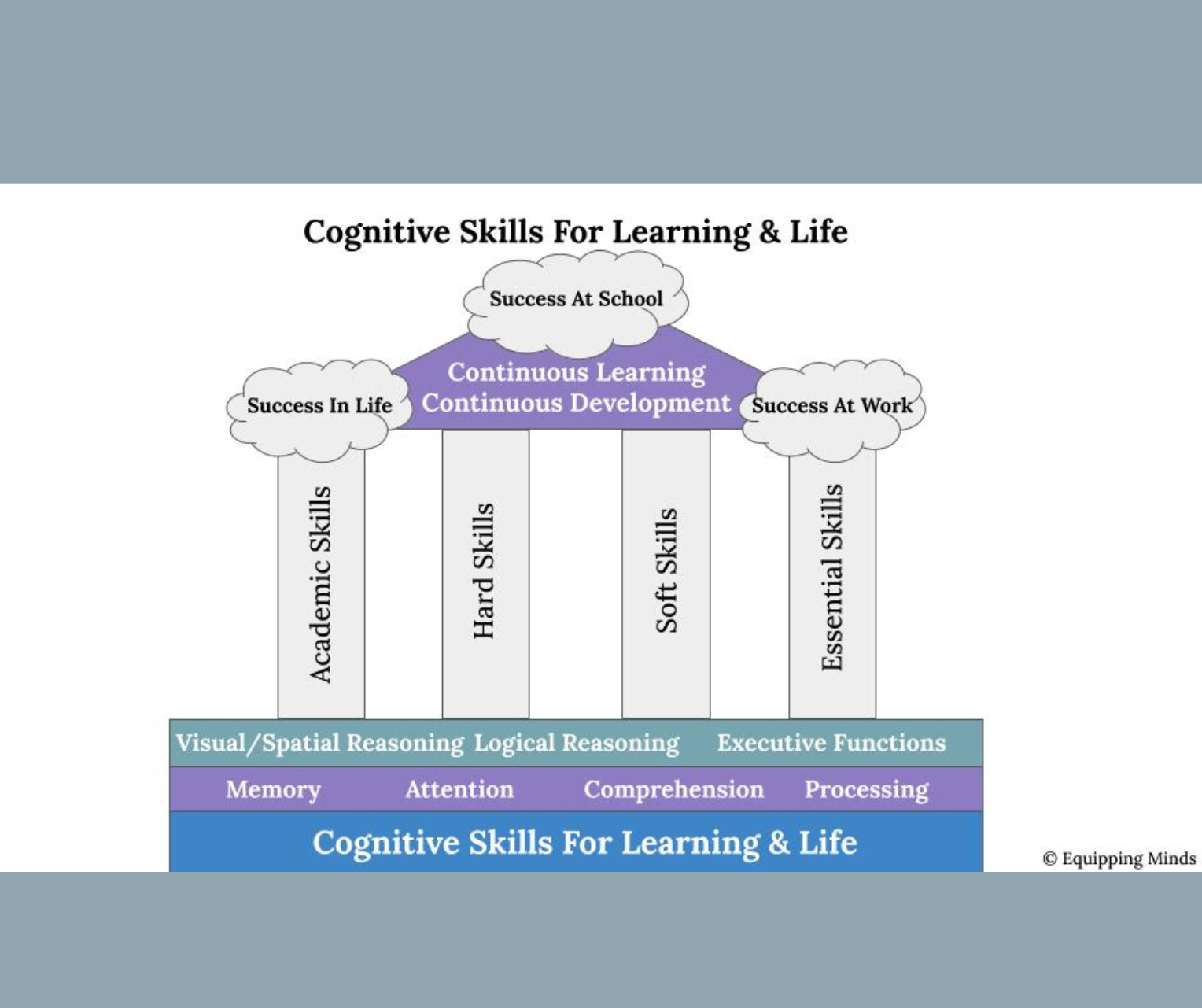
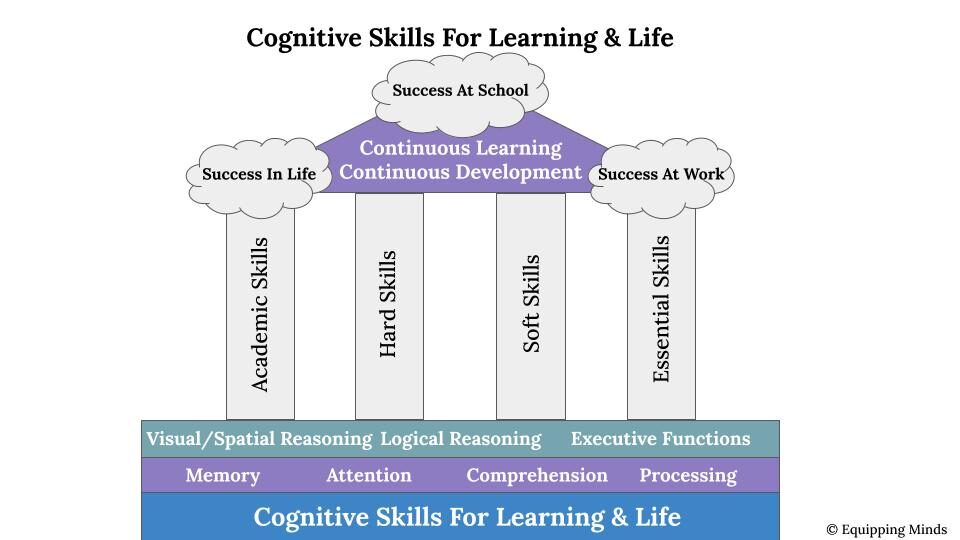
Cognitive Skills for Learning & Life
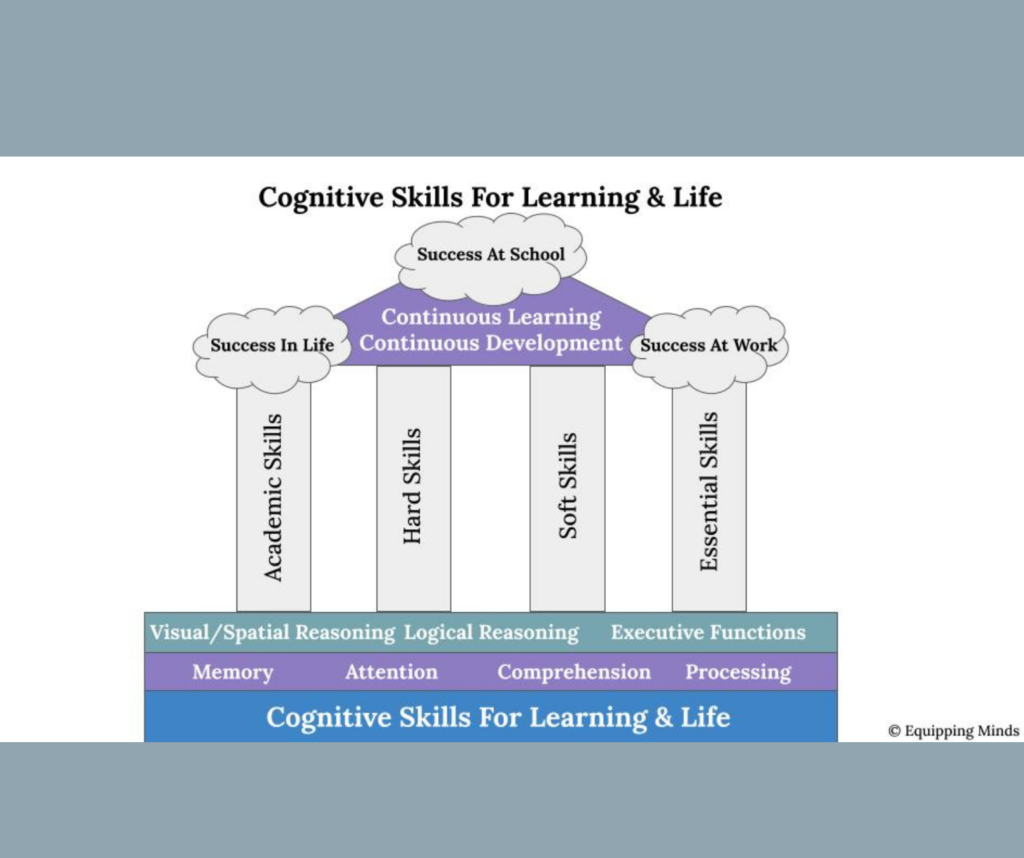
Academic, hard, soft, and essential skills will remain underdeveloped unless cognitive skills are strong. Cognitive skills equip students/employees to learn complex tasks, perform mental calculations, ignore distractions, follow multi-step directions, remember what they read, and plan and think strategically. Equipping Minds is a cognitive training program that provides cognitive tools for learning, including cognitive flexibility, self-regulation, attention, working memory, processing, comprehension, reasoning, and executive functioning. Educators and employers can learn to strengthen these skills that generalize to academic, workplace, verbal, and nonverbal abilities, as well as IQ. Cognitive skills can be taught, learned, and developed. Hence, they are the prerequisites of thinking and learning.
This model can be used by trained teachers, employers, parents, and individuals to better understand and support children and adults experiencing learning difficulties. The emphasis is on strengthening cognitive abilities to ensure successful learning.
I have trained schools, learning centers, and medical centers in over 40 countries since 2010. The results are published in peer-reviewed journals and college textbooks.
This has also been incredibly successful with children and adults with disabilities and learning challenges
Cognitive training strengthens a student’s cognitive skills. Cognitive training yields lasting effects in a short time and can substantially reduce or eliminate the need for future tutoring.Areas where our cognitive training instruction has specifically been applied:
Reading
Spelling
Critical Thinking
Attention
Memory
Listening Comprehension and Reading Comprehension
Writing Skills
Study Skills
Math Reasoning – Math Computation – Math Word Problems – Math Facts
Test Taking Skills
Problem Solving
Academic skills and the Common Core are the subjects we study in school: mathematics, literature, science, history, languages, etc. Students with weak cognitive skills may have many difficulties in academic learning. Tutoring focuses on providing encouragement, support, and instruction in academic subjects such as mathematics, writing, and science. It is usually necessary for most of a student’s academic career.
Reading
For example, reading involves sound-to-symbol connections. One must be able to tell if sounds are the same or different, the order and number of sounds, hold all of those in place, and then read and spell. When one of these skills is weak, students may struggle with reading and spelling. The cognitive skills involved here include the following: visual processing, auditory processing, working memory, long-term memory, and comprehension.
Students struggling to read would begin cognitive skills training with an emphasis on strengthening auditory processing. The students also strengthen their attention, visual processing, short- and long-term memory, and logic and reasoning skills. The therapy includes challenging, engaging brain-training exercises.
Classroom Connection with Equipping Minds. Once the underlying cognitive skills are strengthened, the academic skills become easier. Though we do not train specifically in math, English, or other academic subjects, the students are taught to make the connection to those subjects through vocabulary development, visualization of letters for spelling and reading, oral and written expression, reading comprehension, attention skills, study and outlining skills, and visualization of numbers for math facts and math sense. All of these skills are required throughout life. By improving and automating these skills, the key to learning fast and efficiently is discovered. The Equipping Minds specialist can provide support in writing and curriculum selection if needed.